The rise of a future Ballon d'Or winner: Unveiling Barcelona sensation Sydney Schertenleib's extraordinary journey to the pinnacle of women's football
Sydney Schertenleib's path to becoming the best teenage player in women's football is a testament to her talent, work ethic, and unwavering ambition. This blog post delves into her remarkable journey from training with boys' teams at FC Zurich to making waves at Barcelona and the Swiss national team.
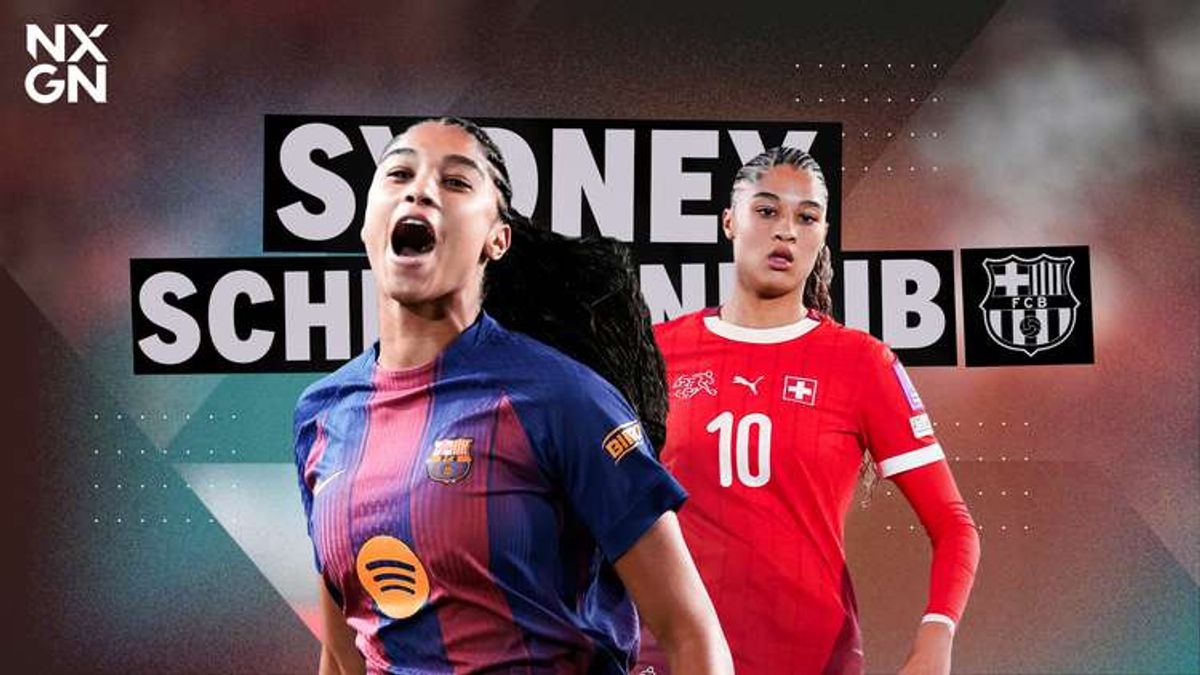
When Sydney Schertenleib sat in front of the national media last summer, before playing in her first European Championship for hosts Switzerland at the age of 18, and declared that her "biggest goal" was to win the Ballon d'Or one day, some may have rolled their eyes."If one young player says [that], I think 80 percent of people think, 'Oh, what an arrogant player. She did nothing until now. How can you say something like that?'" Alexandra Szarvas, a former coach with the Swiss Football Association, tells GOAL. But not she, nor anyone who has worked with Scherteinleib, the NXGN 2026 women's winner, thinks that. Quite the opposite, in fact.To say that to the Swiss media, too, was noteworthy. With a population of just nine million, Switzerland has never been a powerhouse in the world of football. In terms of the Ballon d’Or, only eight Swiss players have made the longlist for the men’s award in its 70-year existence, with no woman yet nominated for the Ballon d’Or Feminin, established in 2018."Normally, for a Swiss guy or a Swiss girl, you have to say, 'She's absolutely crazy when she says that', because we are a small country," Daniel Gygax, who coached Schertenleib in the FC Zurich youth set-up, adds.But anyone who has watched this prodigious teenager play football - be it since she debuted for the Switzerland senior side as a 17-year-old, after she made the move to Barcelona just a few months later, or perhaps even before that - will know that while Schertenleib's goal is certainly lofty, it is not out of reach, not for a player of her talent or with her work ethic."She sometimes says things like that but she does everything to reach that goal," Szarvas notes, and Gygax concurs. "When you saw her in the past, when you see her at the moment, how she plays with such an easy style of football, I understand her and how she talks," he adds. "She trains with Ballon d'Or winners, so why not have a dream like that?"Gygax knew Schertenleib was different before he even got to coach her. Born in Zurich in 2007, she would join FC Zurich’s youth set-up at the age of 10 and always trained with the boys’ teams, “because she had the level already” to do so. Coaching the Under-16s at the time, Gygax was made well aware of the talented young girl that was rising through the ranks before she eventually progressed into his team, a feat which was unusual in itself."Normally, at the ages of 14, 15 and 16, the girls perform until a point, but then you see the [physical] differences, which is very normal," he says, talking about something which would ordinarily lead to those girls leaving the boys’ set-up. "But with Sydney, you didn't see a difference.”That wasn’t the only rarity with Schertenleib, who was also playing with a boys’ team of her age rather than one a year younger, the latter of which is often the case with girls in the boys’ set-up in Switzerland. Training in this environment would only help to further develop the remarkable talent she already possessed. "It’s quicker, the level is higher, you have fewer breaks, and when you train all day with the boys, your body and skills get better and better and better," Gygax explains. "It was, I think, the right decision at that moment to choose that she can train as long as she can with the boys."It was something that became particularly apparent when Schertenleib went away with the youth national teams. Gygax recalls her returning to Zurich after one camp and expressing disappointment at the two weeks of training she had missed out on with the boys’ team: "When she went with the youth national teams, she had no opponent, because it was so easy for her."The level Schertenleib was at was reflected in how she was integrated into the youth national teams, too. "She was always the youngest in the team,” Szarvas, previously part of the coaching staff with Switzerland’s U16, U17 and U19 youth national teams, recalls. “The first camp, when I met her in the national team, we, all the coaches, saw that she's unbelievable. She has unbelievable potential to become maybe one of the best in the world and you could really see that she was just one of a kind.”There was one thing, however, that Szarvas was quick to pick Schertenleib up on - her counter-press. The teenager had no idea she had been shirking that responsibility so consistently, and when told about it, she would work on addressing that flaw immediately. It’s something she still brings up to Szarvas today as something she’ll never forget, something she knows she had to learn in order to get to where she is now.It’s a story that offers a glimpse into the personality and mentality of Schertenleib, an example of how she will always work to improve and how she is, as Szarvas describes, “a team player”.“She's really, really nice and very humble, even though she already achieved so many things in her career at this young age,” her former youth national team coach adds.Despite her talent and the progress she was making, Schertenleib would have to leave her childhood club to kickstart her senior career. FC Zurich chose to bring her into the women’s first team on a full-time basis, taking her away from the U16 boys, but she wouldn’t get much game time. "I was very surprised," Gygax says. "She was one of the biggest talents. She was the only girl who trained until the U16 stage with the boys."What Schertenleib did next suggests Gygax wasn’t the only one who was surprised. After one season in Zurich’s first team, which ended in a league title, the teenager left to join Grasshoppers, who had been defeated by the eventual champions in the play-off semi-finals. Grasshoppers didn’t have a squad on the same level as Zurich, sure, making it easier for Schertenleib to break into the side, but she showed her former club what they were missing out on when she did.In one season with Grasshoppers, she played more senior football than ever before, won her first Switzerland call-up and made her international debut. Then came the big move.Add GOAL.com as a preferred source on Google to see more of our reportingThe story around Schertenleib joining Barcelona is worth telling. She was in such a formative stage of her career at the time of the Catalans' interest that she didn't even have an agent, so one of the club’s scouts sent her a message on Instagram in order to obtain some contact details. Schertenleib’s sister saw the message first and told her father, who brought it up before Schertenleib had any knowledge of it. “Huh? What about Barcelona?” she replied. Not long after that, the 17-year-old had signed for the reigning European champions.On the face of it, it might not have seemed like a good move, not for a young player who had not played a lot of senior football and needed game time to develop. But although Barcelona is a huge club with an incredibly successful women’s team, it is also excellent at developing young talent on both the men’s and, as has become increasingly apparent in recent years, the women’s side.Schertenleib would start in the B team. There, she would get used to the club’s unique style while also adjusting to life in a new country, being away from home at such a young age and learning a new language. It was a challenge she took to like a duck to water. She made her first team debut in November 2024, as a substitute in a 4-0 win over Eibar, and never looked back.From there, she remained with the likes of Alexia Putellas and Aitana Bonmati in a season that ended in a domestic treble, a Champions League final and some impressive individual numbers. In her first year with the best team in Europe, and perhaps the world, Schertenleib had played 22 games, made eight starts, scored two goals and provided three assists. The foundations were laid.But more important was the impact Barcelona was having on Schertenleib. Pia Sundhage, the head coach of Switzerland at the time, went out to Catalunya with some of her staff to check on the teenager midway through her first season. Sundhage admits to being surprised by the move initially. but once she saw the teenager in that environment, it all made sense. "In the very beginning, she practised and played with the second team, but very soon, she played with the big stars," the 66-year-old tells GOAL. "When you watched that practice, you could tell that she liked to be with the very best, to play with the very best, to compete with the very best. So, all three of us said, 'Well, that was a good move. She is going to be successful'."Szarvas, meanwhile, noticed the impact it had on Schertenleib’s development as a person. Visiting her earlier this season, the two were chatting over lunch when the now-head coach of Hungary said: ‘Oh my god, you are so adult now!’When Schertenleib returned to Switzerland, the way she was developing in Barcelona became even more noticeable. "Something happened with her endurance, with her physical capacity," Sundhage recalls, while also noting the "confidence" the teenager had gained from taking such a big step in her stride.Quickly, despite her age and relative inexperience, Schertenleib would become a key player for Switzerland, in a year that would see the nation host the 2025 European Championship. For a team that had never got out of the group stages at the tournament, it was going to be a big deal.When GOAL asks Sundhage what made her put so much faith in Schertenleib at such a young age, and in such a big moment, there is almost a trace of confusion in the Swede’s voice, as if to say, ‘Have you not seen her play?’ After all, we are talking about a player who is so technically outstanding that Veronica Maglia, her former Switzerland U17 coach, described the ball as being "virtually an extension of her body". But GOAL wants to hear from a manager of Sundhage’s experience and legend, in her own words, just what it was that she was seeing from this incredible talent at such a young age."I just looked at the performance in training and she did well so, for me, when we talked about the starting 11 and who is actually ending the game as well, we never looked at the age," she replies. "In the very beginning, yes, but it was absolutely sure that she could withstand the pressure." When the Euros came around, where she would make her major tournament debut, Schertenleib was suddenly a poster girl. "I saw her in the publicity, on the television and on the posters in the town," Gygax, now proudly watching her career flourish from afar, remembers. The 18-year-old would start three of Switzerland’s four games at an historic Euros which saw La Nati get out of the group stages for the first time. Attendance records would be broken, the hearts of the nation would be captured and proud tears would flow before, and after, an admirable 2-0 loss to Spain in the quarter-finals.Speaking after her side’s win, La Roja head coach Montse Tome would credit her centre-backs for "managing situations with Sydney", who she noted as "dangerous in open spaces".Through a Schertenleib lens, for Switzerland’s campaign to end at the hands of Spain, who fielded an XI featuring nine Barcelona players, felt fitting, because it highlights one of the most fascinating aspects about her career ahead. At club level, she plays for one of the very best teams in the women’s game. But her international career will play out with a nation in a lower tier.At Barca, she is a small fish in a big pond, and even if she goes on to become the world-class player many expect, she will always be surrounded by star power. With Switzerland, she is already becoming a big fish in a small pond, aged 19. She has, and likely will have, entirely different levels of pressure and expectation on her individual shoulders in the two environments over the course of her career. "I'm very curious to see how she will handle these two different worlds," Szarvas concurs. But, as she notes in the same breath, Schertenleib has the right sort of "personality" for this challenge.She has the drive and the ambition, the traits that made her declare to the national media that she wants to win the Ballon d’Or. But she also has the humility and hard-working attitude that meant she didn’t finish that statement there: "But first I want to get better and gain experience. I'm learning from the best at Barca, but also in the national team. I'm confident that I can do it. But I'm also trying to keep my feet on the ground."Schertenleib is a star, but she’s also always there for the team. "Sydney has always had high goals and now that she is competing with the best in the world, she realises that this is the real deal," Maglia explains. "But I am convinced that she got there because she represents great values that were passed on to her at home. If she always manages to stay true to herself, she will have a lot of fun and so will we all.""I think those who will be successful for a long time, they do have good values," Sundhage adds. "They are grounded and they are comfortable to be uncomfortable, and in the long run, they will be successful." It sums up Schertenleib brilliantly. Couple that with the remarkable talent that she possesses, and it’s no wonder her big dream to win the Ballon d’Or doesn’t feel so outlandish.
Sydney Schertenleib's Unconventional Journey
From training with boys' teams at FC Zurich to signing with Barcelona at just 17, Schertenleib's journey is a tale of defying norms and challenging expectations. Her dedication, skill, and determination set her apart from a young age, paving the way for her meteoric rise in women's football.
Barcelona's Impact on Schertenleib
Joining Barcelona's youth setup proved to be a pivotal moment in Schertenleib's career. Immersed in a competitive environment alongside top players, she honed her skills and mindset, rapidly adapting to the demands of elite football. Barcelona's nurturing of young talent played a crucial role in shaping Schertenleib into the star she is today.
Schertenleib: The Rising Star of Swiss Football
As Schertenleib excelled at Barcelona, her influence on the Swiss national team grew significantly. Her performances at the 2025 European Championship showcased her talent and composure on the big stage. Despite playing for a smaller footballing nation, Schertenleib's impact and potential have garnered widespread recognition.
Balancing Ambition and Humility
Schertenleib's ambitious pursuit of the Ballon d'Or is matched by her humility and team-oriented mindset. Her dedication to continuous improvement and learning from the best reflects her maturity beyond her years. Striking a balance between personal goals and team success, Schertenleib exemplifies the qualities of a true footballing prodigy.
The Future of Women's Football: Sydney Schertenleib's Legacy
As Schertenleib navigates the dual worlds of club and international football, her journey symbolizes the evolving landscape of women's football. With her exceptional talent, values, and determination, she is poised to leave a lasting impact on the sport and inspire future generations of young players to dream big and work hard.